

I was listening to Strong Message Here, the satirist Armando Iannucci’s excellent BBC podcast on the power of words, in which he and comedian Stewart Lee attempt to understand the strange linguistic universe that AI has created for us. They were joined by ethical AI policy expert Sarah Wynn-Williams, who, for legal reasons, is not allowed to say anything negative about Meta, an excellent recurring joke in a world where tech giants now sponsor their own criticism.
The episode explored AI hallucinations, those flattering lies models tell with great confidence. Stewart Lee discovered that Grok had declared him “irrelevant” because he had never sold out an arena in the United States – a career objective he has never attempted. ChatGPT, for its part, reportedly announced he was dead. This is the problem with machine confidence: the polish of certainty applied to something fundamentally invented.
Toward the end, the conversation turned to a far more interesting point:
from 2026, human-generated content will command a premium
And they’re right.
We’re approaching a cultural inversion. AI will soon be able to produce infinite amounts of generic material, passable ads, competent jingles, plausible newsreaders and apparently, right-wing power ballads praising Charlie Kirk (because no actual rock star would record one). When anything can be generated instantly and cheaply, scarcity (and therefore value) shifts elsewhere.One of the most striking dynamics in this new AI-saturated world is the return of something profoundly analogue: people want to hear real humans. Just as vinyl surged back when music became frictionless, and mechanical film cameras saw a renaissance when photography became infinite, we are about to see the same cultural correction in video

One of the first Vloggi episodic video blog templates was for a series called Analogue Travelogue designed for record collectors to film snippets of their crate digging and for our system to stitch together into seamless, consistent episodes. We knew the vinyl scene was ripe for authentic, not generative AI video content.
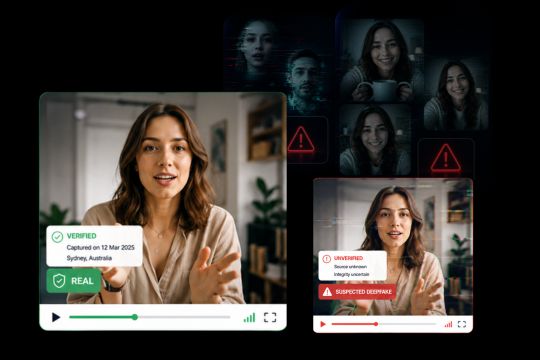
Because, when synthetic media becomes cheap and ubiquitous, the value of anything human spikes.
This is why the “citizen soapbox” angle of video crowdsourcing matters.
During the RFK Jr campaign, we saw it first-hand: supporters didn’t want to fill out polls or click sentiment buttons, they wanted to speak. They wanted their voice, their tone, their identity, their moment in time to be seen. But crucially, the campaign needed to know that these were real voters, not AI-generated avatars or outsourced bot farms.
A verified human speaking into their phone — stumbles, background noise, imperfect lighting and all — carries an authenticity no model can mimic. It is the political equivalent of a vinyl crackle: a tiny imperfection that proves it’s real.
And as deepfake generation tools multiply from beyond the troll farms of St Petersburg and onto literally every device on the planet, this proof becomes indispensable.
Generative AI can produce flawless generic content, but it cannot reproduce the unrepeatable nuance of a real person filming themselves on a street corner between errands, giving their unscripted view of the world.
Human-generated video is not just a media format. It is becoming a democratic artefact — something whose legitimacy rests in its provenance.
This is exactly where Vloggi sits:
AI handles generic content; Vloggi captures authentic, verifiable human content.
When everything synthetic becomes abundant, the human — like analogue music or film — becomes rare, valuable, and absolutely worth preserving.
The premium moves to the human. To the flawed, emotional, unrepeatable. To the verified.
Just as live musicians suddenly become more valuable in a world of machine-generated pop, authentic video, recorded by actual people, in actual places, becomes the antidote to synthetic persuasion.
In mass-produced AI advertising, the real artistry will be worth more.
In an era of deepfakes, verified video becomes evidence.
As the BBC trio noted, the future is arriving unevenly. But one thing is already clear: when synthetic content becomes infinite, the human becomes priceless.
And we’re building the infrastructure to protect it.
Originally posted 2026-05-27 13:29:56.