AI assurance isn’t just a compliance trend — it’s the new moat. And for small tech firms, it’s both a barrier and a breakthrough.
For years, enterprise procurement has worked on a fairly predictable cycle: innovate, demonstrate, negotiate, secure the deal. But the arrival of AI across every business function has turned that rhythm inside out. Suddenly, the question is not whether your product solves a problem. The question is whether your product is safe.
And safety, it turns out, is expensive.
In recent weeks, one of the world’s largest financial institutions published new guidelines for third-party suppliers of AI systems. Their message was blunt: if you want to sell software into an enterprise environment, you must now provide full AI assurance documentation. Not marketing statements, not a responsible AI slide at the end of the deck, but detailed evidence:
- where your training data came from
- how your models were developed
- what fairness assessments you ran
- what you’re monitoring for drift
- how you manage access, security, and provenance
In other words, the age of “just ship it” is officially over.
When Big Tech Comes Knocking
It is always a thrill to be approached by massive organisations. Over the past couple of years, we have had Google reach out from New York—an engagement we ultimately won after their lawyers conducted a forensic sweep of our entire architecture. UTS in Sydney put us through a full security review, which we passed. These wins matter.
But we have also lost enterprise clients for reasons that had nothing to do with product capability. NRMA, a large roadside assistance company in the Australian state of New South Wales and Amazon in Europe both walked away because we did not check every security box they required. They did not question the value proposition. They questioned whether a small team could meet a heavyweight protocol.
That’s the brutal arithmetic of the enterprise market: without funding, it is difficult to harden your product to enterprise grade. And without enterprise-grade compliance, you don’t win enterprise clients. Investors look at that and say, “Come back once you have enterprise traction,” thereby completing the catch-22.
The New Barrier — and the New Opening
The tightening of AI governance rules looks, at first glance, like yet another obstacle for early-stage companies. And it is. No point pretending otherwise.
But it is also an extraordinary opportunity.
Because these new requirements do something unusual. They force enterprise buyers to ask questions many AI vendors can’t answer. Questions about provenance, chain of custody, transparency, auditability, and control. Questions that favour companies whose products were built for evidentiary integrity from day one.
In our case, Vloggi’s entire architecture is based on verifiable inputs, secure storage, documented capture environments, and traceable workflows. AI assurance isn’t a burden we have to bolt on. It has been the backbone of the product since the beginning.
As the market shifts, the values we built around—authenticity, provenance, a forensic audit trail for human-generated video—are suddenly not “nice to have” features. They are becoming procurement gatekeepers.
The Rise of the Assurance Economy
The UK’s Department for Science, Innovation and Technology, the British Standards Institute, and ISO have been quietly laying the foundations for an AI assurance market predicted to add more than £6.5 billion to the economy within the decade.
But of course, the European Union leads the way — as it so often does in matters of consumer protection — with the AI Act. Brussels has made provenance central to the discussion, much as it has for years through protected designation of origin in food and wine, where origin, traceability, and method are audited, certified and enforced. The logic is the same with digital products: if people are going to consume it, they deserve to know exactly where it came from and whether it has been tampered with.
Yet even the EU acknowledges the double-edged sword. European entrepreneurs warn that every layer of protection arrives wrapped in red tape. Better safeguards, yes — but also more bureaucracy, slower innovation, and another compliance cliff that smaller firms can’t easily scale.
Across the Atlantic, the picture is more… improvisational. The United States remains a regulatory wild west, particularly under the current pay-to-play administration, where industry influence often sets the tempo faster than policy can catch up. Provenance and assurance are talked about loudly, but codified weakly. In practice, responsibility shifts to enterprises themselves, who decide which standards to enforce and which they’re happy to overlook.
Still, the trajectory is the same everywhere: banks, insurers, and large government departments will be the first major adopters of formal AI assurance. And once they move, the rest of the economy tends to follow.
This shift is also creating a new category of professional: the Responsible AI practitioner. A hybrid of ethics, engineering, governance, and risk. These specialists will soon be as essential as DevOps was a decade ago.
For startups, this means two things:
- You cannot afford to ignore AI assurance, because procurement teams won’t.
- But if you embrace it early, it becomes a strategic advantage rather than a barrier.
The Enterprise Procurement Frontier
The message from the financial sector is clear: security and trust are no longer compliance exercises. They are competitive differentiators. Companies that can evidence their claims—rather than assert them—will rise to the top of vendor lists faster than those with a glossy demo and an opaque model.
We are living through a profound turning point.
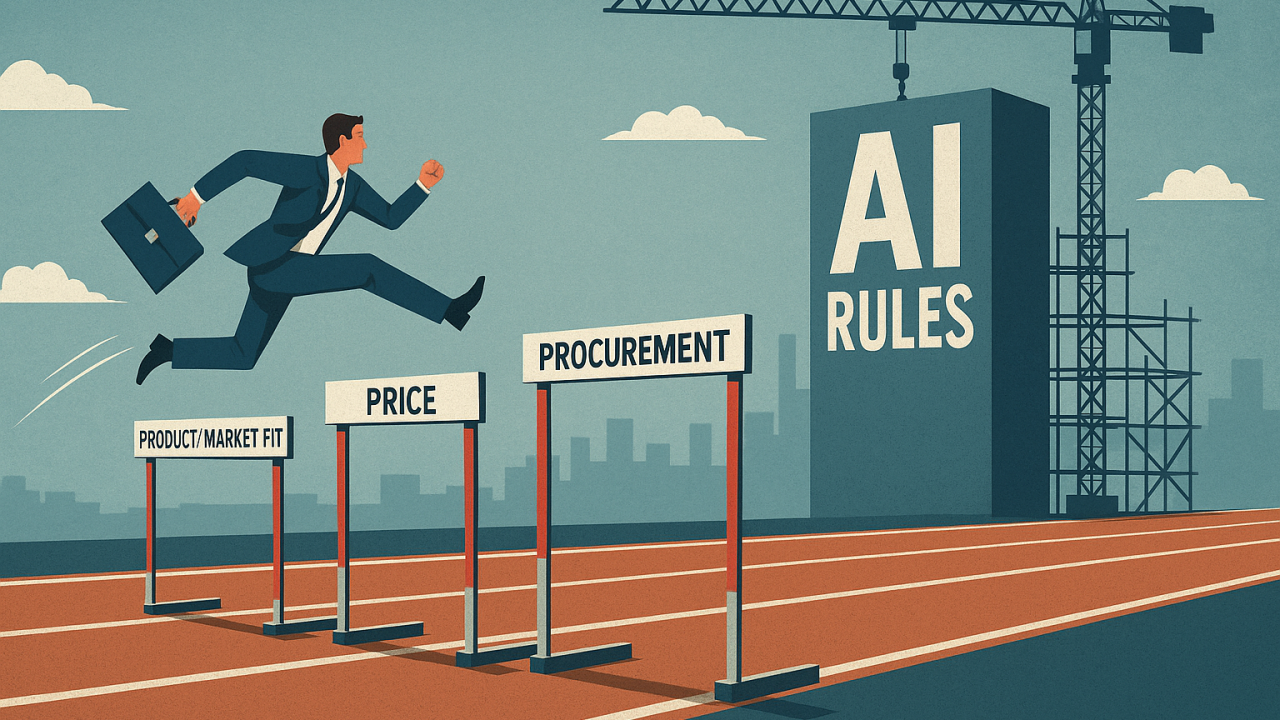
The walls of enterprise procurement are getting higher.
But there are now fewer vendors capable of climbing them. For the right companies, this moment is not a threat, it is the opening.
Originally published in Proof in Motion on LinkedIn.
Explore Vloggi Verify and video consent tools, or get started with Vloggi.