
About Keep Randwick Beaches Free
Keep Randwick Beaches Free is a community action group formed to oppose the introduction of visitor parking meters near Randwick City’s beaches. The campaign brought residents, beachgoers, local precinct groups, and businesses together around a simple principle: public beaches should remain accessible without creating a new financial barrier.
The group needed to make that community opposition visible and personal—not merely a number on a petition. Video gave supporters a direct way to explain who would be affected and why free beach access mattered to them.
Project overview
- Client: Keep Randwick Beaches Free
- Project: Save Our Beachside Parking
- Use case: Community advocacy and video petition
- Location: Randwick City, Sydney, Australia
At a glance

78 video petitions collected

140 individual written submissions recorded by Council

A new civic-participation format people readily adopted
Context
Keep Randwick Beaches Free used Vloggi to collect 78 video petitions from residents and beachgoers opposed to paid beach parking. That compares with 140 individual written submissions recorded by Council—more than one video petition for every two written responses. Even though video petitions were the newer participation format, people readily used them to put real faces, voices, and lived experience at the center of the debate.
The challenge
Turn opposition into evidence people would remember
Traditional petitions demonstrate scale, but a list of names cannot always explain why an issue matters to each person who signs it. Keep Randwick Beaches Free wanted residents and beachgoers to describe, in their own words, how paid parking could affect family beach trips, accessibility, local businesses, and the character of the community.
The campaign needed to make it easy for people to contribute from a phone, collect authentic first-person testimony, and bring many individual voices together in one organized campaign. The goal was not simply to gather content. It was to create a video petition: a body of civic testimony with faces, voices, and personal reasons attached.
Wider context
Why the campaign worked
It made the issue human
Supporters were not reduced to signatures or survey percentages. Their faces, voices, and personal experiences became part of the evidence.
It gave many people one collective platform
Seventy-eight individual videos became a shared public argument: free beach parking mattered to a broad and engaged community.
It complemented formal submissions
The video petition reinforced substantial written opposition documented in the council’s own report, including 115 opposing individual submissions and unanimous opposition among the four submitting precinct committees.
It gave decision-makers something memorable
Policy submissions can be abstract. First-person video testimony is direct. The councillor’s reported reaction shows that the campaign material landed emotionally as well as politically.
Sources: Randwick City Council consultation and decision update; Randwick City Council report on submissions. The video petition formed part of a broader community campaign; this case study does not claim that the videos alone caused the council’s decision.
The solution
A community-powered video petition
Using Vloggi, the campaign invited supporters to record and submit short videos explaining why they opposed paid beach parking. Contributors could respond in their own voice and from their own surroundings, without emailing large attachments or navigating a complicated production process.
The workflow
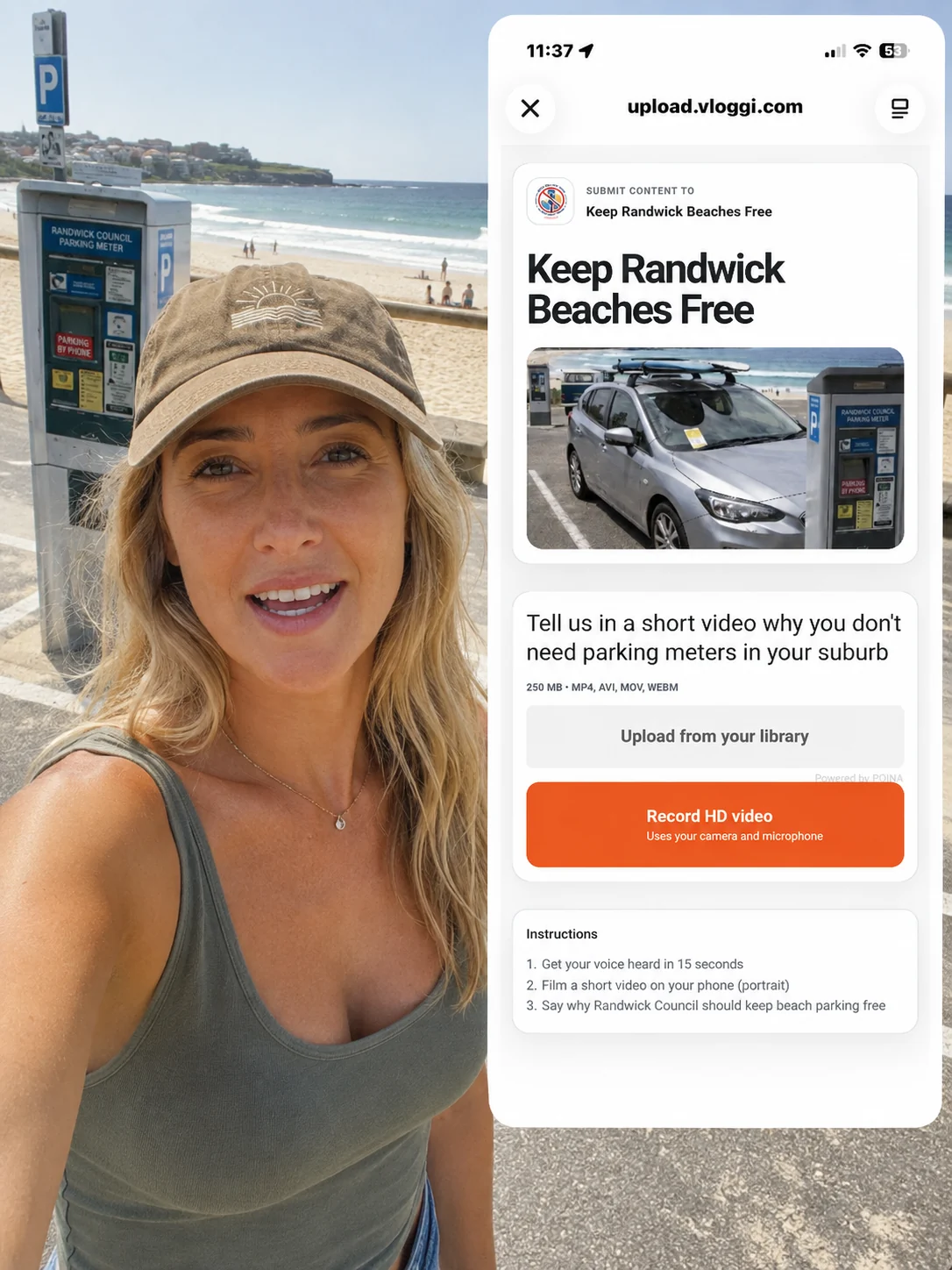
Each submission added another perspective to a growing collection of local testimony. Vloggi gave organizers one secure place to collect and review those contributions, keep contributor context together, and turn the strongest responses into campaign-ready video. In total, Keep Randwick Beaches Free gathered 78 video petitions—a notable participation rate beside the 140 individual written submissions recorded by Council, particularly for a newer civic-engagement format.
The videos complemented a broader written campaign. Randwick City Council’s submissions report found that 115 of 140 individual written submissions opposed the proposal. It also recorded opposition from all four precinct committees that submitted formal resolutions: Bays and Beaches, Clovelly, Maroubra, and Matraville.
The result
People power helped stop the parking meters
On 30 June 2026, Randwick City Council rejected the revised proposal. Councillors voted not to introduce visitor pay parking in beachside areas, ending further action toward installing parking meters. Council instead resolved to consider other funding sources and alternative parking-management tools.
The decision followed a broad consultation process and sustained community advocacy. The 78 video petitions were one distinctive part of that response: personal, visible evidence that helped campaigners put human experience at the center of the debate.
A written petition can show how many people care. A video petition can show who they are, why they care, and what a decision would mean in their lives.
In their words
“The video petitions scared the hell out of us.”
Randwick City councillor, speaking at the subsequent council meeting