
Real customer videos give your audience something an AI avatar cannot supply: a customer’s own account of using your product or service. For a testimonial, community campaign or customer story, the person’s experience is the content.
If you are looking for alternatives to AI video, start by separating presentation from proof. An avatar can deliver a script. A customer can explain what changed, show how they use a product and describe the details that matter to another buyer. Vloggi helps you collect those contributions through a simple browser invitation.
When should you use real customer video instead of an AI avatar?
Use real people when your message depends on a real experience. That includes a customer explaining a result, an enthusiast showing a product in use, an employee describing their work or a community member sharing a perspective. The contribution matters because of who experienced it.
| Your objective | Ask for |
|---|---|
| Help buyers understand a product | A customer demonstration in their own setting. |
| Explain a purchasing decision | What the customer needed and why they chose you. |
| Build a customer story | The problem, the experience and a specific outcome. |
| Activate a community | A short response to one shared challenge or question. |
Do not begin by writing a polished testimonial for someone to read. Give the contributor a clear question and room to answer in their own words. A useful detail from an actual experience can be more persuasive than another version of your brand slogan.

Five prompts for authentic customer videos
- “What were you trying to do before you found us?” Establishes the situation another buyer may recognise.
- “Show us how you use it.” Creates a practical demonstration rather than a general endorsement.
- “What changed for you?” Invites a specific result without putting a claim in the customer’s mouth.
- “What surprised you?” Opens space for details your marketing team may not have anticipated.
- “What would you tell someone considering it?” Makes the response useful to the next buyer.
Choose one or two prompts for the first invitation. A long questionnaire can turn a simple contribution into homework. If a longer customer story needs several answers, make the sequence clear and explain how the videos will be used.
How to collect real customer videos without organising a film shoot
1. Pick one audience and one story
A first-time buyer, a long-term customer and a product enthusiast have different experiences to share. Choose a specific group and a relevant question. For example, ask customers who have just completed onboarding what helped them get started, rather than asking everyone for “a testimonial”.
2. Send a browser recording invitation
Tell contributors what to record, how long the response should be and where it may appear. With Vloggi’s video submission software, contributors respond through a browser link. They do not need to coordinate a film crew or install an app to contribute.
When authenticity at capture is essential, choose the controlled recording workflow. Video recorded through Vloggi’s controlled workflow is tamper-proof and cannot be faked. This gives a real-human campaign a clear starting point instead of relying on how convincing an uploaded clip looks.
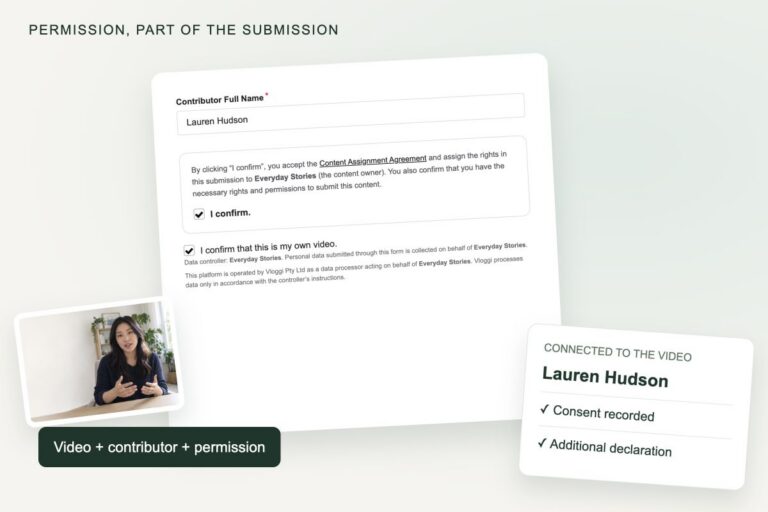
3. Make permission part of the submission
Collect consent and any additional declarations with the contribution. Explain the intended use in language contributors can understand. A social campaign and an internal research project may need different information.
Automated video release forms in this workflow mean connected consent and additional declarations, so the team reviewing a video can find its associated permissions too.
4. Review for useful detail
Ask whether the clip answers the prompt and helps another customer understand the experience. Look for clear speech, relevant footage and a usable explanation. Preserve what the person means when trimming an answer. If a point needs clarification, ask a follow-up rather than rewriting their experience.
5. Give every selected contribution a purpose
A product demonstration belongs near the relevant product explanation. A story about getting started can support onboarding. A short answer to a common buyer question can become a social clip. Match the contribution to the question it actually answers.
A real example: customers creating footage in the field
JAX Tyres & Auto’s customer video campaign invited its 4×4 community to contribute their own footage. It illustrates a useful campaign pattern: start with something customers already care about, give them a clear way to participate and organise the contributions for the marketing team.
Your equivalent might be a product-in-use challenge, a community story or a customer tip series. The invitation should fit the people you are asking, rather than make every audience imitate the same studio testimonial.
Turn one customer story into an Instagram content series
Plan the outputs before asking for footage. A single clear answer may support a short Reel, a quote-led carousel and a longer story on your website, where the permissions cover those uses. Keep the source contribution connected so your team can check wording and context.
- Reel: open with the customer’s problem, show their experience and finish with the relevant next step.
- Carousel: use one idea per slide: the situation, the action, the customer’s observation and the takeaway.
- Website: place the full story beside the product or service it explains.
- Follow-up: invite another customer to answer the same focused question.
Measure the campaign against its job. Track usable contributions and visits to the relevant page, then follow through to demo bookings or completed signups. Views alone do not tell you whether the content helped a buyer act.
What if customers are not confident on camera?
Make the task small. Ask for a short answer, offer an example of the kind of detail you need and suggest recording somewhere quiet with light in front of them. Encourage their own wording. The objective is a clear contribution from a real person, not a performance that sounds like an advertisement.
Build your first real-human video campaign
Choose one customer group, one question and one useful destination for the footage. Explore customer video testimonials with Vloggi or book a demo to map your first campaign.